
NEET UG 2026 Results Out: 11.21 Lakh Qualify, But Only a Fraction Will Get an MBBS Seat in India
The National Testing Agency (NTA) declared the NEET UG 2026 result on July 16, 2026, ending months of anxious waiting for nearly 20 lakh medical aspirants across the country. The scorecard is now live on the official website, neet.nta.nic.in, and candidates can download it using their application number, date of birth, and security PIN. Here's a breakdown of what the result actually means for students planning their medical education journey — and why, for a growing number of them, that journey may not end in India.
The Headline Numbers
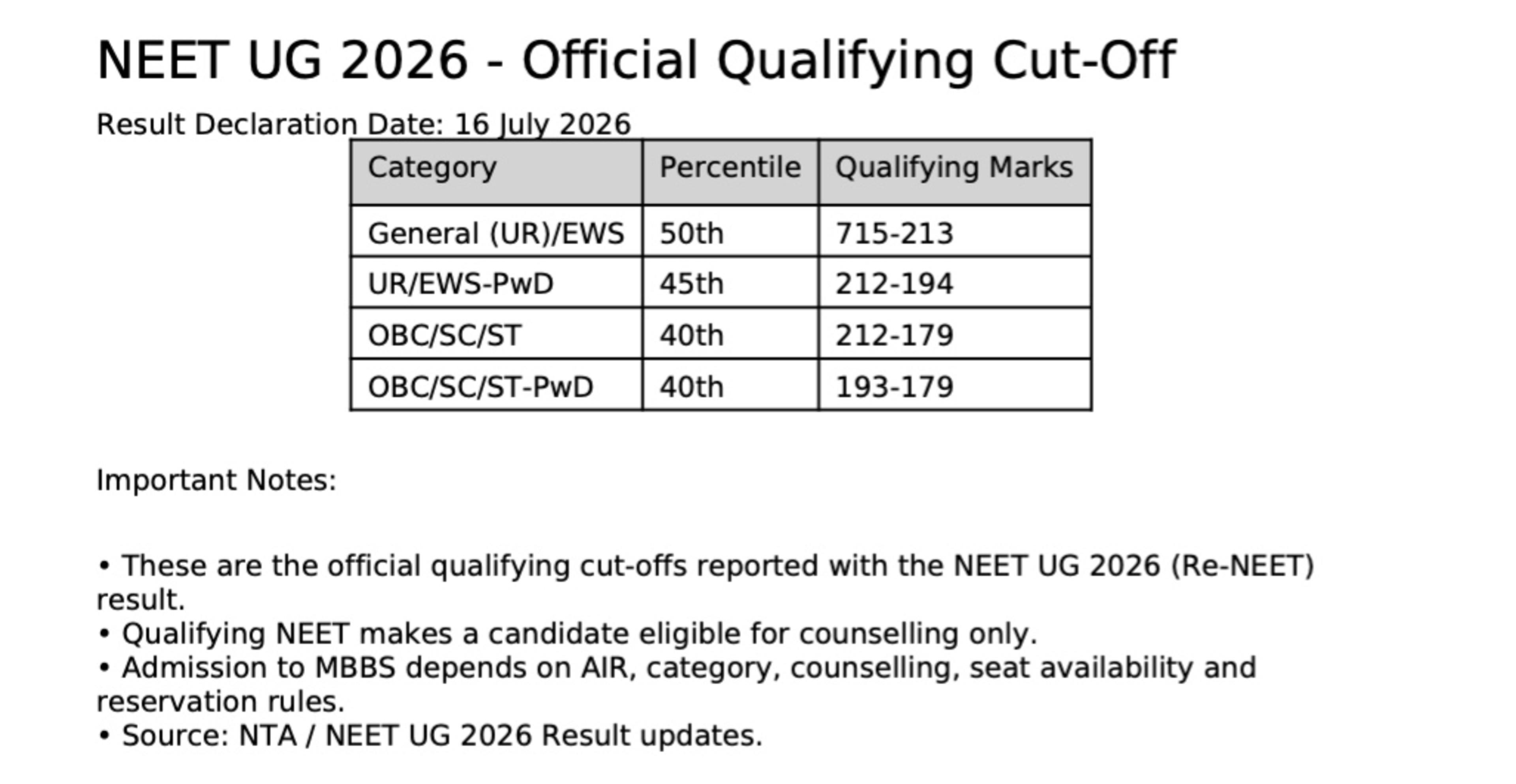
Out of the nearly 20 lakh candidates who appeared for NEET UG 2026, 11.21 lakh have qualified for admission to undergraduate medical, dental, AYUSH, and allied health programmes. Two candidates jointly topped the exam with a score of 715 out of 720, and NTA has released a full score distribution so students can gauge exactly where they stand in a brutally competitive field. A few other highlights from this year's result: Women outperformed men. More than 58% of all qualified candidates are women, with a qualification rate of 56.8% compared to 55.1% for men — continuing a multi-year trend of rising female representation in Indian medical education. Pan-India participation. Candidates from all 36 states and union territories have qualified this year, underscoring just how nationwide the competition for a medical seat has become. Category-wise cutoffs released. NTA has published qualifying cutoff marks and percentiles for each category alongside the result, which will determine eligibility for counselling.
Qualifying Is Only Half the Battle
Here's the number that rarely makes the headlines but matters most: India has around 1.18 lakh MBBS seats across all government and private medical colleges combined. That means even though 11.21 lakh students have qualified NEET, fewer than 1 in 10 of them will actually secure an MBBS seat in the country this year. For students who scored well but not well enough to make it into a government college — or who don't have the ₹80 lakh to ₹1.5 crore that private medical colleges and deemed universities in India typically charge for the full course — the qualifying mark on a scorecard can feel less like an achievement and more like the start of a much harder decision.
What Qualified Students Should Do Next
- Download and verify your scorecard — check your marks, All India Rank (AIR), category rank, and 15% All India Quota (AIQ) rank carefully for errors.
- Register for MCC or state counselling, depending on the quota you're eligible for.
- Research realistic college options based on your rank, not just your aspirations — rank predictors and previous years' closing ranks are a good starting point.
- Keep a backup plan ready before counselling rounds begin, especially if your rank falls in the middle bracket where seat allotment can go either way.
When the Rank Doesn't Match the Dream
Every year, a large number of students who are genuinely capable of becoming good doctors end up without an MBBS seat in India — not because they lack merit, but because the seat-to-aspirant ratio simply doesn't work in their favour. This is exactly the gap that has pushed lakhs of Indian students toward MBBS programs abroad over the past decade. Countries like Uzbekistan, Kazakhstan, Kyrgyzstan, Georgia, and Armenia have become popular, practical alternatives — offering NMC-approved MBBS programs, English-medium instruction, significantly lower total course costs, and a curriculum aligned with what students need to clear the FMGE/NExT and practice back in India. For students whose NEET score qualifies them under the national cutoff but doesn't translate into an Indian college seat, these destinations offer a legitimate, well-trodden path to becoming a doctor. If your NEET 2026 rank hasn't opened the door you were hoping for, it doesn't mean the door is closed — it means it's time to look at it from a different angle.
Confused about your next step after NEET 2026? Talk to an IntelAbroad counsellor to understand which NMC-approved MBBS abroad options genuinely fit your rank, budget, and career goals.