
"Should we spend our savings on a private seat, or send our child abroad?"
This question comes up every NEET season. Both paths lead to a medical degree, but they don't cost the same, feel the same, or suit every student equally. Here's a straightforward comparison to help you decide.
Admission Process
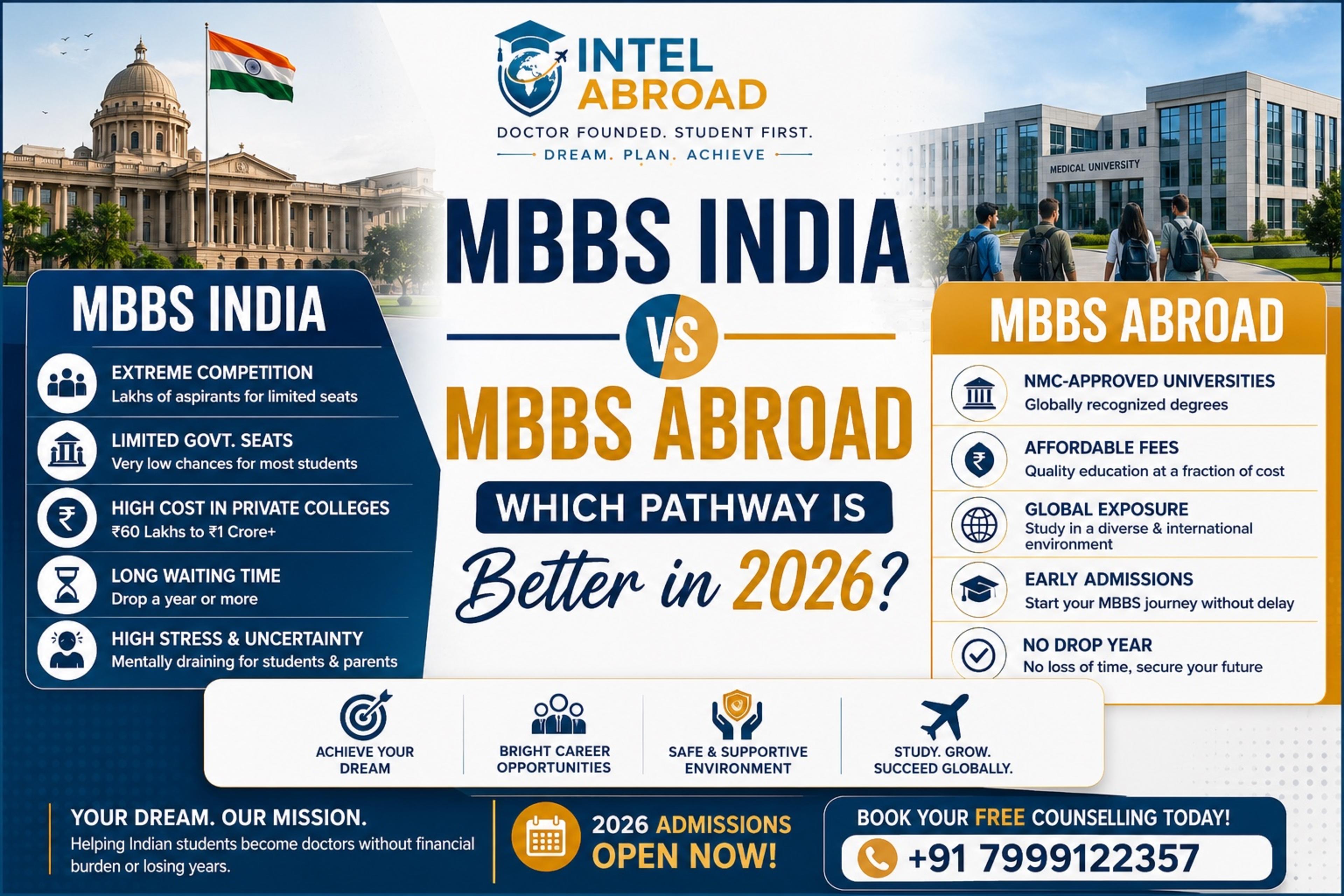
Private colleges in India operate through NEET counselling rounds. If that doesn't secure a seat, there’s often a management quota process, which involves its own paperwork and stress. Studying abroad is simpler on paper: you need a valid NEET score, your Class 12 marks, and to apply directly to the university. There are no repeated rounds or last-minute scrambles in September.
Cost Comparison
This is where the real discussion starts. Private MBBS in India can range from ₹60 lakh to over ₹1.3 crore for the full course. That’s before any unofficial "donation" some colleges expect. MBBS abroad, in countries such as Georgia, Uzbekistan, or Russia, usually costs between ₹28 lakh and ₹50 lakh, which includes tuition and living expenses. Many families looking for affordable MBBS options abroad tend to choose these countries for a reason.
Education Quality
In Private Medical colleges in India the student teacher ratio is approximately 100:1 which may impact the attention on per student knowledge transfer quality while MBBS abroad has a teacher to student ratio of 1:20 which increases the attention span on students by teacher.
NMC Recognition
This is essential. If you’re going abroad, the university must be on the NMC-approved list and in the World Directory of Medical Schools. After graduation, foreign medical graduates still need to pass FMGE to practice in India. NExT is expected to replace it eventually, but there’s no confirmed date, so plan around FMGE for now. Failing to check this could mean ending up with a degree that's hard to use back home.
Career Opportunities
Once you are licensed, the playing field is fairly equal. Both groups can sit for NEET PG and work in government or private hospitals. Foreign graduates sometimes benefit from cross-cultural exposure, while private college graduates may find it easier to adjust to the Indian academic system right away. Neither option is a dead end; that’s clear from the doctors we’ve stayed in touch with over the years.
Comparison at a Glance
| Cost | India: ₹60L – ₹1.3Cr+ Abroad: ₹28L – ₹50L |
| Admission | India: NEET counselling + quota. Abroad: Direct, based on NEET |
| Licensing after | India: Not required Abroad: FMGE (currently) |
| Seats | India: Limited, competitive Abroad: Comparatively easier |
Who Should Choose Which?
If money isn’t a concern and you have a spot in a reputable private college, staying home offers real comfort. However, if you have to choose between an average private seat at a high fee and a recognized university abroad at a third of the cost, is MBBS abroad worth it? For most families that reach out to us, the answer is yes.
FAQs
- 1. Is MBBS abroad valid in India?Yes, if the university is NMC-approved and you pass FMGE after returning.
- 2. Do I need NEET for MBBS abroad? Yes, it’s mandatory for every Indian student, regardless of destination.
- 3. Is FMGE still required in 2026? Yes. NExT may eventually replace it, but no official date has been confirmed.
- 4. What’s the average cost of MBBS abroad? About ₹28–50 lakh total, though this varies by country and university.
- 5. Can I do NEET PG after MBBS abroad? Yes, once you clear FMGE and obtain NMC registration.
Not sure which country fits your NEET score and budget?
Talk to an IntelAbroad counsellor for a straightforward and honest comparison. There’s no pressure, just clarity. Book your free session today.